All writings and photos used here are/or may be copyrighted. That means you must request use.
email. gene9156@yahoo.com

Central States Lawman and Outlaws Historic Assoc. In the late 1800s - and early 1900s The River of humanity flowing west, was both wide and deep. Caught in the current of manifest destiny, were settlers, soldiers, business interests, and Outlaws. It was a perfect whirlwind of the Wild west. G.C. Stevens
All writings and photos used here are/or may be copyrighted. That means you must request use.
email. gene9156@yahoo.com
The following story was compiled by John G. Pierce of
Chariton Iowa.

INTRODUCTION BY BLOG AUTHOR
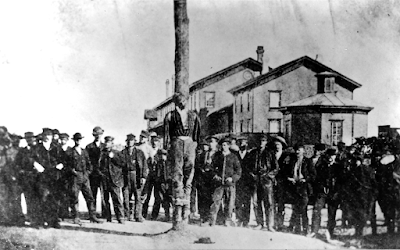
Iowa is almost overlooked when it comes to the stories of outlawry in the region. However, there are many forgotten stories from the past, including the first train robbery in the west that occurred in Adair Iowa in 1873, the outlaw Frank Rande who went on a crime spree in Illinois, Iowa and Missouri and the Barrow gang shootout in Dexter Iowa in 1933. Another lessor know incident happened in Chariton Iowa in 1870, when the local Sheriff Gaylord Lyman was alerted that there was a possible horse thief heading to Chariton. A letter that was allegedly received from Northern Missouri warned him to be on the lookout. On July, 6, 1870 Sheriff Lyman confronted a suspicious character, which resulted in gunfire and the murder of Sheriff Lyman by outlaw Hiram Wilson. The booklet shown here was created by Author John G. Pierce, he gave me permission publish it directly from his work.
-Gene Stevens




-John Clum's book, It all happened in Tombstone.
The Ghost's of Tombstones past still hangs heavy over the town that wouldn't die.
-The Author
John was aware that a plot existed before hand.
He tried to keep it a secret. But there were many enemies in Tombstone.


Located between Des Moines Iowa and Omaha Nebraska, runs a lessor known historic roadway called "White Pole Road". The road is a very unique American by-way. It was once the way west in the early days of the automobile. It currently runs Parallel to the famed I-80 But for those who would prefer to avoid Interstate 80 will find themselves traveling along a quieter, more historic stretch of road. Unbeknownst to modern travelers, this part of Old US Highway 6 was not only the sight of a type of heist heretofore unheard of in the American West in Adair Iowa.
It was also near the same road that the Barrow gang, of the famed outlaws Bonnie and Clyde were located and shot up by law enforcement and deputies near Dexter Iowa at Dexfield Park in 1933. But most significant is the train robbery of 1873. The telling of the story of this history-altering event is etched upon a modest marker just over a mile west of Adair, Iowa, located off County Road G30. Here, an upright train car wheel marks the spot where, on the summer of July 21, 1873, Jesse James and his gang pulled off the world’s first robbery from aboard a moving train. The following account of the train robbery is based upon written materials both old and new, and newspaper articles of the day.


To Understand Wyatt Earp, you must know Nicholas Earp.
-Scott Dyke
Sound bites in historic documentaries, and Hollywood movies do true research a great disservice. The story of Nicholas Porter Earp the father of the famed Wyatt Berry Stapp Earp, is one figure in American history that deserves a better investigation.
Nicholas Porter Earp was born the son of Walter and Martha Ann Earp in 1813. He married Virginia Ann Cooksey and his most famed son Wyatt was born in 1848.. Nick was an adventurer, Entrepeneur, soldier, Sergeant and political leader. For some reason, these aspects of Nick Earps life are glossed over, as juxtaposed against Wyatt Earps life, like a comma in a sentence or an abbreviation.
Environmental Historian Andrew Isenberg (PBS documentary on Wyatt Earp) described Nicholas Earp as " colorful, larger than life... But to round him out, he was a dead beat, and that he skipped out on debts and was a drinker". But to describe Nicholas from the 21st century perspective is nearly impossible, and lost on the modern historian, who fails at understand how difficult peoples lives really were during this time. Nick was a strong father figure, a military Sergeant in a time when all warfare conducted on the new frontier was brutal and bloody. He had crossed the continent during war time and experienced things that very few modern men could survive.
The Earp family was of English and Scots-Irish descent. The first Earp immigrants to arrive in the American colonies was Thomas Earp Jr., who arrived in Anne Arundel County on July 6, 1674, as an indentured servant from Ireland. He is buried in St. Anne's Parish in Annapolis. Nicholas was named for a circuit-riding judge in Kentucky. Nicholas' father Walter Earp was born in Montgomery County, Maryland, in 1787, a fifth-generation Marylander who later became a school teacher, Justice of the Peace in Monmouth, Illinois and a Methodist Episcopal preacher.
Nicholas' mother, Martha Ann Early, was born in Avery County, North Carolina, on August 28, 1790. Nicholas was the third of ten children; his siblings include six brothers: Lorenzo Dow, Josiah Jackson, James Kelly, Francis Asbury, Jonathan Douglas and Walter C (twins); as well as three sisters: Elizabeth, Mary Ann, and Sarah Ann. When Martha Earp died at age 91, she had eight living children, 85 grandchildren, 130 great-grandchildren and 13 great-great-grandchildren.
Soon after Nicholas' birth, the family moved from Virginia to Hartford, Kentucky, in 1813, where Nicholas spent the rest of his childhood. As a young man, Nicholas may have served in the Black Hawk War of 1831 though, no record of this is found in the state of Illinois Black Hawk War Records online. We do however know that he served as a sergeant in the Mexican–American War. During the Mexican–American War Nicholas served under Captain Wyatt Berry Stapp of the Illinois Mounted Volunteers. Then during the Civil War, Nicholas served in Pella, Iowa, as a United States Provost Marshal for recruitment. His sons Newton, James, and Virgil enlisted in the Union Army on November 11, 1861.
While his father was busy recruiting and drilling local companies, Wyatt, along with his two younger brothers, Morgan and Warren, were left in charge of tending the 80-acre corn crop. Only 13 years old, Wyatt was too young to enlist, but he tried on several occasions to run away and enlist. Each time his father found him and brought him back home.
WAGON MASTER
May 12, 1864
Forty wagons and one hundred and fifty emigrants line up at Pella, Iowa. Nicholas "Captain" Earp leads the caravan across the Missouri River into Omaha Nebraska and beyond. Sixteen year old Wyatt is in charge of Earp wagons and stock. He also draws the hunters job and with a gift from his father of an under and over combination rifle and shotgun, he is able to keep a group of twenty people in fresh meat all the way to California.
- The Illustrated Life and Times of Wyatt Earp, by Bob Boze Bell.
The story of Wyatt's boyhood surroundings is carried to the point where his father resigns from the Army (Provost Marshall Position) and with his family begins the covered wagon journey to California.
-Letter to Ira Rich Kent, Houghton Mifflin Co, From Stuart Lake in reference to the content of Wyatt Earp, Frontier Marshall.
We know quite a bit about the Earps trip to San Bernandino California, thanks to a member of his wagon train Sarah Rousseau. She was the wife of Doctor, born into a well to do English family in 1816 by the name of Sarah Jane Daglish, according to Author Nicholas Cataldo, She "bloomed into a highly educated woman". When she came to America, she lived for a while in the Michigan area, presumably the Michigan Territory, as Michigan gained statehood in 1855.She married Physician husband James A. Rousseau and they moved to Kentucky in 1839 before eventually moving to Knoxville Iowa.
So it's also probable that Sarah Jane at sometime in her early life encountered native Americans. This is mentioned because multiple encounters with Indians would occur in the coming months. It just so happens that sometime shortly after the move to Knoxville, they decided to risk the distant, arduous and highly dangerous trip to California by way of wagon train. And Nicholas Earps plans for moving Wyatt and his family out of the area from their home in Pella Iowa began after brother Jims discharge from the union army. The civil war would soon be over and the flood of pioneers moving to the west, was just beginning for the ghost of manifest destiny that would drive people far into the interior of the continent.


Reprint from April 2014

Photo Library of Congress William Quantrill of Co. C, Quantrill's Missouri Cavalry Company Summary Photograph shows identified Confede...


