Saturday, May 4, 2024

The Luke Short, Charley Storms Shooting; By Gene Stevens


Luke Short                       Charley Storms
                                              Courtesy Emory Cantey

                                          INTRODUCTION

                              The subject of this narrative might have died with

                                his boots on, for he had many chances, but he

                               didn't...

                             - Lawman Bat Masterson on Luke Short

Luke Short was Gambler and member of the Dodge City Peace commission during the famed “Saloon Wars” who moved to Leadville, Colorado, in 1879, Where he formed his reputation as a gambler and gun slinger. The famed Lawman Bat Masterson later wrote in his book “Famous Gunfighters of The Western Frontier” that Short had seriously wounded a man during a gambling dispute in Leadville. When Luke settled in Leadville Colorado and began a career of gambling, he became acquainted with wealthy socialites of higher class. And was thrown into a society of rich mine buyers, as well as mining promoters. It was the first place where he had ever seen a game of faro played, and he was fascinated.


Many a Cow-boy and gambler lost at the faro tables of the
gambling establishments in western towns
Photo from awesome.com
One day Luke ran afoul with a bad man with a gun in one of the camps (sic Bat Masterson), prominent gambling houses. The “bad man” himself who had a record of violence attempted to take some liberty with Luke Short during the faro game. Short told the man to keep his hands off his bets, there was a short exchanged of unpleasantries. The faro dealer was scared out of his wits and thought the “bad man” would fill Short full of holes. The dealer however underestimated short, as the “bad man” reached for his pistol, short was quicker on the draw and pulled his pistol in a flash and stuck it in the 'bad mans” face and pulled the trigger. Ther “bad man” did not die, and there was no arrest or trial. Such things happened in Leadville every day.                                                                                                                            

                                        The Gunfight with Charlie Storms

                                                Snuffing out a Gambler

Luke Short first met Wyatt Earp, William H. Harris, and Bat Masterson in Tombstone. Harris knew Short previous to this time, and had no problem convincing his partners to engage Earp as a faro dealer at the Oriental Saloon in Tombstone Arizona. On Friday, February 25, 1881, Short was acting as a lookout for the faro game, He was seated next to the dealer at a faro table in the Oriental, when he was involved in what became a well-known gunfight that was covered by several newspapers and remembered in Masterson book "

Famous Gunfighters of the Western Frontier" His antagonist, was Charlie Storms, who was also a fairly well known gambler. Bat Masterson, who was in Tombstone during this time, described what happened in a magazine article he wrote in 1907:

Storms did not know Short, and like the bad man in Leadville, had sized him up as an insignificant-looking fellow, whom he could slap in the face without expecting a return. Both were about to pull their pistols when I jumped between them and grabbed Storms, at the same time requesting Luke not to shoot, a request I knew he would respect if it was possible without endangering his own life too much. I had no trouble in getting Storms out of the house, as he knew me to be his friend ... I was just explaining to Luke that Storms was a very decent sort of man when, lo and behold!, there he stood before us, without saying a word, he took hold of Luke's arm and pulled him off the sidewalk, where he had been standing, at the same time pulling his pistol, a Colt's cut-off, 45 calibre, single action; but like the Leadvillian, he was too slow, although he succeeded in getting his pistol out. Luke stuck the muzzle of his pistol against Storm's heart and pulled the trigger. The bullet tore the heart asunder, and as he was falling, Luke shot him again. Storms was dead when he hit the ground.


Storms' body was taken to the town undertaker, where a coroner's jury was convened in haste, and testimony was heard. The jury reached a verdict quickly stating that Storms died from three pistol wounds at the hands of Short, and that Short's actions were justifiable. Short was free to go, as no further legal action was taken.


                                                   Two Articles located on

                                                  Newspaperarchive.com
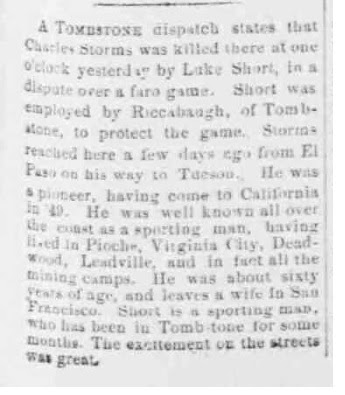


Phoenix AZ Herald
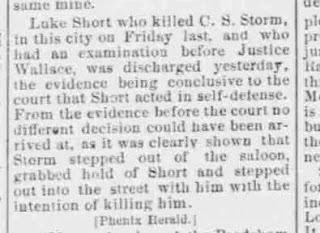


Case was discharged by Justice Wallace on grounds of self-defense


LUKE SHORTS TESTIMONY FROM THE DEADWOOD PIONEER NUGGET

March 13, 1881
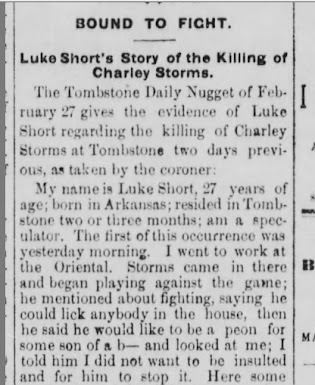


The spring of 1881 found Luke Short in Tombstone Arizona, dealing faro in a house managed by Wyatt Earp.

-Bat Masterson
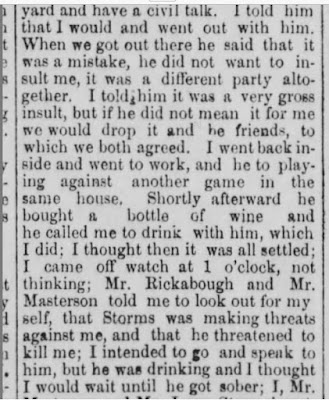

Luks Short testimony continued
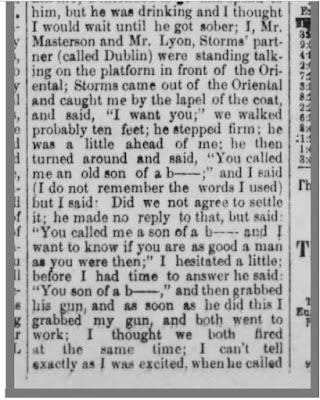


Storms' body was taken to the undertaker, where the coroner's jury was convened and testimony was heard. The jury reached a verdict that Storms died from three pistol wounds at the hands of Short, and that Short's actions were justifiable. Short was free to go, as no further legal action was taken. 

Five days after Storms died, the Leadville Democrat wrote about the shooting. It said that

Storms approached Short and "catching him by the ear", demanded an apology. According to the account, Storms grabbed Short's ear with his left hand and his right hand contained a pistol aimed at Short. Short drew his weapon and shot Storms, who returned fire, but missed. Short then put two more bullets into "the sinking soul of Storms.

 On February 28, 1881, at the Oriental Hotel, gamblers Luke Short and Charlie Storms had a verbal altercation which was deescalated by Bat Masterson, who was also an acquaintance of Storms as well. Storms later returned to the scene and walked up, said nothing and pulled a gun, On Storms, a cut-off Colt .45 pistol, but Short was quicker. Short shot Storms twice before he hit the ground; the first shot fired was so close that it set fire to Storms' shirt. Short was said to have then turned to Bat Masterson and stated: "You sure pick some of the damnedest friends, Bat." Ben Sippy arrested Short, but the shooting was determined to have been made in self-defense.


Photo from the Authors Collection

Wyatt Earp

Wyatt Earp would later say

that he helped to carry the body of Charlie

Storms back to the San Jose rooming house

where the now-deceased gambler and Lyons

had been staying, so that a post mortem could

be performed by Dr. Goodfellow.

-Peter Brand 2015

"The Killing of Charlie Storms by Luke Short"

Photo from the Authors collection

Bat Masterson;

Bat Masterson Claimed that he was a direct witness of the shooting, 

This claim is most likely correct.


Photo from the Authors collection

Luke Short

In the Spring of 1881, Luke Short was dealing Faro at the Oriental Saloon in Tombstone Arizona which was managed by Wyatt Earp. There was an incident between Luke Short and Charlie Storms over a gambling issue and guns came into play.. Bat Masterson was present and intervened in the disagreement and initially deescalated the situation. Masterson managed to cool things down, and escorted Storms to his room. Bat Masterson was friends with both Charlie Storms and Luke short. But Storms and Short didn't know one another. Masterson walked back over to Short and was trying to explain to Short that he thought Storms was a decent guy, when as Bat stated " When... lo and behold, there he stood before us." Storms said nothing but started to pull his pistol. Unfortunately Luke Short was faster, pulled his gun, stuck the muzzle of the gun to Storms heart, and pulled the trigger.

-Bat Masterson


He probably died instantly. Bat Masterson tells us in his book that Luke was given a quick hearing in front of a Magistrate and was quickly exonerated .Bat Masterson was present in Tombstone and attended the hearing

-Famous Gunfighters of the Western Frontier.

W.B. (Bat) Masterson
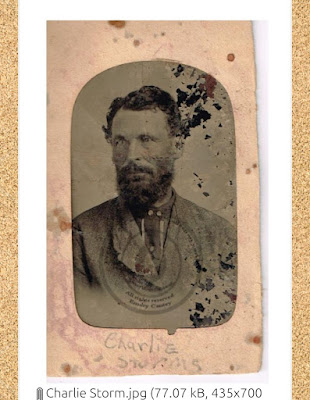
Photo of Charlie Storms from the

Cantey (Myers) Collection 

This unique image of Charlie Storm came in a group of personal items pertaining to Luke Short sold by his relatives. Luke Short and Charlie Storm were involved in a gun fight in Tombstone, Arizona in 1881. It may be the only known image of Storm.


A well known photo of the Dodge City Peace Commision.


                                                      Luke Short date unknown

Friday, May 3, 2024

Central States Lawman and Outlaw H.A. May News Letter

 The Central States Lawman and.          Outlaws Historic Association 

 Writing the other side of the story


Thursday, May 2, 2024

Photo Investigation, Morgan Earp... Confirmed ; By Gene Stevens


Photo from Curley Bill has been killed 
by Glenn Boyer, Facing page opposite page 1
Assassinated on the Streets of Tombstone
In Tombstone, Arizona, on March 18, 1882, an assassin fired a rifle through the back door window of Bob Hatch and John Campbell’s saloon, killing Morgan Earp while he was playing a game of billiards. The first shot hit Morgan in the spine, and the second hit the wall near where his brother Wyatt was sitting.


There's an old saying, "curiosity killed the cat, but satisfaction brought him back". This is the genealogist's bread and butter.  For those of us who are diggers... Wannabe archeologists, this is where we thrive. There is a quiet but active network of diggers out there, people who stay awake late at night, modern technology keeps us talking between each other sometimes until 2 or 3am. Sometimes sleep is interrupted by trips to our personal libraries to seek confirmations, which leads to additional emails to our sources of information. It was just that kind of late sleepless night that and some nagging question about photos of Morgan Earp. As we all know, there are many photos out there. But as I have personally said, each photo needs individual examination. Anything short of this is unethical and criminal.

The Morgan Earp Photo
Glenn Boyers "Curly Bill Has Been Killed at Last"

At Tombstone, Wyatt had been deputy sheriff from July to November 1880. Morgan replaced him as Wells Fargo messenger when Wyatt became Deputy Sheriff .
-Glenn Boyer

In 1997 Glenn Boyer published a booklet called  " CURLEY BILL Has Been Killed at Last".
The book is a reflection of the saga of Wyatt Earps vendetta against the Cow-boy factions of Cochise County Arizona . Morgan Earp had been assassinated by members of the Cow-boy factions of the deserts around Tombstone.  But these are well known and sharpened fact. As I was collaborating with some other writers on the topic of Morgan Earps photo, the ongoing burning question arose.. Which photo is the authentic photo of Morgan Earp?
Photos of Glen Boyers booklet and autograph

But then it occurred to me that, somewhere in my personal library, I had seen a photo of Morgan, but it had been sometime, though I had an idea of where it was at. And BINGO. I went to my book shelf and pulled out Boyers book and there it was by page one of Curley Bill Has Been Killed. From there the photo made other connections. So I reached out to Author Scott Dyke. Scott was Glenn Boyers closest confidant in Glenns later days. It was Scott who helped disseminate Glenn's collection after had passed,
His (Dyke's) collection has several previously unknown artifacts germain to the Tombstone/Earp story and has copies and some original paperwork of the Boyer collection; gifted by Boyer. Dyke also has found/bought other paperwork and pertinent documents via his own research. 

Cover from Boyer's pamphlet, Morgan Earp
Brother in the Shadow.

According to Scott Dyke;
Boyer got that pic of Morgan from the family of Louisa Houston, his (Morgan Earp's) widow. (common    ( law) Emory (Cantey) had to buy it from Glenn. That is the correct one
-Scott Dyke

Photo courtesy of Emory Cantey     


Emory Cantey also told me that, yes, he purchased the photo from Glenn Boyer. Cantey has also told me that he considered Glenn a Father figure. 

-Gene Stevens


Tuesday, April 30, 2024

The Wyatt Earp, Stuart Lake Letters; Transcribed by Gene Stevens


Photo from the Authors Collection


Wyatt Earp Aficionado and Devotee's

One U.S. Main St.

Anytown USA


Dear Wyatt Earp Aficionado, 

There are in this world, men of substance, action and being, who by Gods grace are placed in their time and location to influence the world around them. Its easy to wax philosophical over such men, and to ponder over men like Wyatt Earp. Especially by the men who sometimes ponder history. They pour over texts, letters, diaries, records and old tintype photographs trying to nail down the persons or times in which the lived, contemplations grow within their minds. But behind the mask, is a desire. The desire takes on many forms of intentions, they range from the most sincere actions of the heart, to the most evil intentions of destruction. But the hind site of time, history, age and health, can temper the hardest of souls. I know this is true of Wyatt Earp, who was a man of substance, action and being. A man who wore a badge of authority, but the badge never made him who he was. He made the badge what it was supposed to be. The evidence of this can be found not in the semi fictional, but in the many documents that he left behind, which eventually came into possession of Writer and Earp historian Glenn Boyer. Direct evidence in the way of records and letters were donated to the Arizona Historic Society (AHS) from Glenn Boyers collection. The AHS has in their possession hundreds of pages of documents between Wyatt Earp, Josephine Earp, Stuart lake and Houghton Mifflin publishers. Stuart Lake and Wyatt Earp had formed a very tight, cooperative and cordial relationship as Lake had begun his journey to write Wyatt Earps biography, "Frontier Marshall". I have begun the process of purchasing copies of these letters with the intent of showing the public what is in these files, as I believe that the truth should be revealed for all of those who want to know what really happened, rather than examining it through the lens of Hollywood. My original intent was to photograph and publish each letter, however AHS has exercised copyrights over all copies and requires a $25.00 fee for each page that is placed on public display, not to mention that AHS also charges $1.50 per page printed. It is therefore cost prohibitive to display each page. I can however transcribe each page. On one hand this will be very time consuming, but on the other hand, I will indeed gain much knowledge from closely examining and transcribing each page. I will do my best to recreate the look and feel of every letter, so that the reader has a full feel for its contents, which was written by first generation typewriters and context. I look forward to this endeavor, and I hope the reader will benefit from this article.

                                                Very Sincerely

                                                Gene Stevens

Letter dated; July 22, 1928,from Wyatt Earp to Stuart Lake;


                                          4002 West Seventeenth St.                                            Los Angeles, California                                               July 14 1928                                                                22    

Mr. Stuart N. Lake                                                    3916 Portols Place,                                                  San Diego, California.


Dear Mr. Lake;

    My work on the desert, for the season, is completed, and there is nothing now that might inter-fere with anything that I might have in mind. There-for I am wondering if it will be convenient for you to come to Los Angeles next week, preferably the latter part. 

When you were here several weeks ago. I thought to come to San Diego, as I explained to you. However, such an arrangement does not seem feasible now; my health is not as rugged as I would like it, and several matter of business pending would require my presence here. I hope your coming to Los Angeles would not prove a real inconvenience to you; I regret indeed to have to make this suggestion. 

     I must not forget to explain that we are mov-ing next week, to 4004 West Seventeenth Street-in the same court, the bungalow that faces down the middle; so please look for us there; I shall expect you. Mrs. Earp joins me in kind regards.

                                          Very Sincerely

                                           Wyatt S. Earp

-------------------------------------------------------------------------------------------------

                        July 25, 1928

 Mr. Wyatt S. Earp                                             4004 West Seventeenth St.                                     Los Angeles.

Dear Mr. Earp:      

             I was sorry indeed, to learn that your health is not exactly as you would like it; also, that you are not coming to San Diego as you planned. We think this is the most delightful summer place in the country.

         As matters are now, I am sure that I can come to Los Angeles to see you on Thursday, August 2. I hope to get to your house by 10:30 in the morning, but if I do not appear at about that hour, will be there about 1:30. We can then talk over the details for going through the work ahead.

It would simplify things, I think, if you might have your material more or less ready to hand when I come. I can then see what is immediately ahead in the way of necessary preparation for the actual writing I'll have to do, and so can plan more intelligently.

            Will you convey my respects to Mrs. Earp. and expect me, as I said on Thursday, August 2?

                                   Sincerely your,


                                       Stuart N. Lake


Saturday, April 27, 2024

Jesse W. James; Guerilla Operations, The Use of Deception Part I: By Gene Stevens , Co-author Patrick Meguiar


                                                     The Use of Deception


Who was Jesse James? Can we trust photos and artefacts? 

To understand Jesse James and his unit's (gang) operations, one must first understand the duties and tactics of mounted cavalry of the time period. Tactics such as hit and run attacks, destruction of infrastructure, counter- insurgency, reconnaissance and intelligence services were used from the time of the revolutionary war until the post-civil war, and up to and including the Indian Wars. The trans-Mississippi theater of war was a very brutal affair. The border wars had begun ten years in advance of the wide spread American civil war. Armies of the day consisted of large fighting units of infantry, artillery and mounted cavalry. The horse mounted soldier (cavalry) had filled a vital role of the settlement of the west since the early days of American expansionism. Dragoons, meaning; soldiers mounted with rifles and side arms helped in the expansion into the American wilderness. But the term mounted soldier took on a new meaning in western Missouri as union militia had seized control of western Missouri early in the war, and conducted politically driven violent purges of pro-rebellion families who resided in western Missouri. The absence of sanctioned military units left a power void in the western part of the state, which was quickly filled with citizen/ guerilla soldiers fighting a bloody counter-insurgency war on their own soil. The civil war in western Missouri was truly a war between brothers and neighbors. 

But for Jesse James, the war would continue to rage for at least another eight years as Jesse and his brother Frank would turn the war against the new world order that had been forced upon the post war south. The main tools of this continuing war would be based on mounted guerilla tactics, attacks on corporate commerce, propaganda and covert tactics. 

                                                           Multiple Identities

As time passed, it became apparent that there was plenty of confusion about who Jesse James was and what his end game was, as his activities seemed to have no end. It has been rumored that Jesse may have used as many as seventy two different alias names;

In 1881 Governor Thomas T. Crittenden issued a proclamation for the arrest of Frank and Jesse James. By 1882 Jesse James had moved his family back to St. Joseph, Missouri. Still using his alias, James passed himself off as a cattle buyer and brought two new men, Robert and Charley Ford, into his gang to help him scout banks for future robberies.

-Missouri State Historic Society

On Christmas Eve (1881), Jesse and Zee moved their family into a small house atop a high hill overlooking St. Joseph. Living under the assumed name of Tom Howard, Jesse rented the house from a city councilman for $14 a month. He attended church, but did not work for a living.

- www.stjosephmo.gov

It is obvious that James had learned the art of covert ops and espionage well while conducting guerilla operations in western Missouri, and this M.O. (Modus Operandi) had carried into the post-war years. A product of his M.O. was not only using alias names, it also included spreading information and disinformation and maintaining caches valuables and money.

                                                      After Jesse's Assassination

 After his death, collectable items in the way of photos, documents and firearms were sold and passed off as belonging to Jesse James. Though not unique, the selling false historic artefacts has been ongoing for many years and many faked antiquities have found their way into the hands of unsuspecting collectors. What is unique about this particular story is that the so called artefact was apparently sold by Jesse James mother Zerelda Samuel. 

Pistol marked with JJ, may have come from Zerelda James
Courtesy Patrick Taylor Meguiar

The above pistol was allegedly sold by Zerelda Samuel, it was fraudulently
 doctored it to look like it was really Jesse's pistol down to the "J. J." on the grip.  According to Patrick Meguiar the original buyer was a doctor who went to Zeralda to buy a gun belonging to Jesse James and she sold him the pistol with J. J. and signed the letter making the claim it was his pistol. Then it was owned by a gentleman in Bowling Green Kentucky, and was later sold to another private party.  He had the fine case made to hold the pistol, letter from Zeralda and the picture of the man that was killed when the James Younger Gang robbed the bank in Northfield, Minnesota. 

Photo Courtesy of Patrick Meguiar

Letter signed by Zerelda Samuel, Photo of August Sanborn who was killed in 
Northfield Minnesota by the James gang.

Sorting Through the Photos
There is a lot of confusion about historic photos. Adding to this is modern technology which has given history buffs, genealogists and true researchers a mountain of easily accessible data to mine through. But in addition to this, its a fueled phenomena that Author and Wyatt Earp historian Glenn Boyer called "photowishitis".  Though his tongue in cheek statement holds some truth, there are photos out there which may be the real thing, but due diligence must be done on each one to determine the validity of any serious claim.  The same is true with anything that pertains to Jesse James. There are a number of photos of James out there, but the best evidence suggests that the following three photos are indeed Jesse James. 1-3, the final two photos fall into some question. 4-5. 


(1)
The best, known photo of Jesse James
Description from the Library of Congress;

Title: [Jesse James, half-length portrait, facing front, holding handgun at his waist]
Date Created/Published: St. Louis : Taylor Copying Co., [1864] c1882 May 15.
Medium: 1 photographic print.
Reproduction Number: LC-USZ62-3855 (b&w film copy neg.)
Rights Advisory: No known restrictions on publication.
Call Number: BIOG FILE - James, Jesse Woodson, 1847-1882 [item] [P&P]
Repository: Library of Congress Prints and Photographs Division Washington, D.C. 20540 USA http://hdl.loc.gov/loc.pnp/pp.print
Notes:
N7862 U.S. Copyright Office.
Title devised by Library staff.
Copyright stamp appears on upper left corner.
Photograph is a reproduction of an ambrotype. The original ambrotype was a reversed image, making it appear that Jesse James was left-handed, which he was not. (Source: researcher W. Munn, 2020 and historical.ha.com)
Published in: "Famous People" chapter of the ebook Great Photographs from the Library of Congress, 2013.

The Post Mortem photo 

There are many rumors and legends surrounding the death of Jesse James. Some think that James was
not killed by Bob Ford and went onto to live to an entirely different life. Some stories have Jesse living until he was over a hundred years old. However, the best case scenario is still the original story, that being that Jesse James was assassinated by Bob Ford, with Charlie Ford present in the room. Its worth noting that Bob Ford was murdered in revenge for killing Jesse James and Charlie Ford committed suicide  ;

Harrison Throw, James Wilkerson, William C Clay, CD. Axman and Miss Mattie Collins (Dick Liddil's wife) all of Kansas City, arrived this morning, arrived this evening, and at midnight came up to the world's hotel to view the body, all identified it positively as that of Jesse James. Mrs. Little (Liddil?) wept when she saw the dead man and in the severest manner denounced "the cowardly snot" who assassinated him. She went over the story of Mrs. Moulton (Bolton) working up the job on Jesse James to win Dick from her, and proclaimed that Bob Ford had killed her man, he never would have escaped. She was in hopes that Mrs. Samuels and Mrs. James would not suspect her at this time. Mrs. Samuels and Mrs. James accompanied by Mr. James and Mr. Mimms, of Kansas City, will start i n the morning for Kearny with the body of Jesse for burial at the old homestead. The body of Jesse James was shipped from this city onthe 7 o'clock train of the Hannibal and St. Joe railway this evening, in the custody of Marshall Craig of this city and the family of the dead desperado, consisting of L.W. James, a cousin of Jesse R. Mimms, the widows brother, Mrs. James, Mrs. Samuels and two children. It was taken to Kearny, Clay County Missouri, and buried on the James homestead.
-St. Joseph Daily Gazette, April 3-5th 1882 from Bob Ford Was His Name, Jesse James Was His Game" By Sybil Montana 


(2)
The postmortem photo is the best
Evidence and the most verifiable photo of Jesse James.  Photo from 
Description from the library of congress;
Title: [Jesse James dead; clothed; 3/4 length]
Date Created/Published: c1882.
Medium: 1 photographic print.
Reproduction Number: LC-USZ62-42551 (b&w film copy neg.)
Rights Advisory: No known restrictions on publication.
Call Number: BIOG FILE - James, Jesse [item] [P&P]
Repository: Library of Congress Prints and Photographs Division Washington, D.C. 20540 USA
Notes:
Photo by R. Uhlman, St. Joseph, Mo.
Slightly different angle from LC-USZ62-4049.
This record contains unverified, old data from caption card. 
*Thousands of copies of the post mortem photos were created and sent
all over the country.
From the 

Omaha Daily Bee

Thu, Apr 06, 1882 


(3)
A young Jesse James, Photo courtesy of Patrick Meguiar, has a
 verified chain of custody, scientific research And due diligence conducted. 
*See the attached article

(4)
Mistaken Identity 
Jeremiah James 
According to Patrick Meguiar, John Thomas LaRance says this is Jeremiah James. He has dark eyes unlike Jesse's very light blue eyes. John is on the board of the James Farm.


(5)

This may indeed be controversial, but this well known photo of Jesse James, my not be James. 
It has a description on it claiming to be certified by Jesse James widow.
Description from the Library of Congress;
Title
Jesse James
Summary
Portrait, bust, 3/4, facing left.
Created / Published
c1882 May 22.
Headings
-  James, Jesse,--1847-1882
Notes
-  This record contains unverified, old data from caption card.
Medium
1 photographic print.
Call Number/Physical Location
BIOG FILE - James, Jesse [item] [P&P]
Repository
Library of Congress Prints and Photographs Division Washington, D.C. 20540 USA
Digital Id
cph 3a07300 //hdl.loc.gov/loc.pnp/cph.3a07300


.

Tuesday, April 23, 2024

The Lawman of Dodge City KS, Courtesy of the Kansas Heritage Group


                              The Lawmen of Dodge City and Ford County, Kansas

The Dodge City Peace Commission, Photo from the Authors Collection

Dodge City had the reputation as the toughest town and a hell on the frontier, but actually it was not that bad. From roughly 1875 until 1885, Dodge City was in the midst of a business boom thanks to the wagon road economy and the cattle industry. For a town that was the defacto capital of a wide area of southwest Kansas and the Oklahoma and Texas panhandles, it needed law and order. There were many people walking the streets of Dodge City with money in their pockets. Dodge City could not afford to be as violent and reckless as its reputation It therefore hired some of the most respected and courageous lawmen to ever holster a gun.

 On June 17, 1872, the first business (George M. Hoover's and John McDonald's) to locate on the site five-miles west of the Ft. Dodge military reservation opened as a bar in a tent. This was in response to the prohibition of liquor at Fort Dodge. Other businesses soon followed and the Town Company completed its formal organization as 'Buffalo City' on August 15, 1872. The name was changed to Dodge City in October as the US Post Office already had a Buffalo, KS.

Ford County was not yet organized and did not have a sheriff until June of 1873. Likewise, Dodge City was not incorporated until November 2, 1875. For the first year, there was no government or law enforcement. It was this period that much happened to help give Dodge it reputation as a very wild and dangerous place.

  The first recorded killing in Dodge City was in September 1872, when an African-American man named Black Jack was shot for no reason by a gambler known as Denver. Shortly after that, Jack Reynolds was killed by a railroad track layer. In that first year, approximately fifteen men were killed in Dodge City, all being buried up on historical Boot Hill. Eventually, Boot Hill were have some 30 graves, including one female, Alice Chambers.

  By early 1873, the local merchants were concerned about the violence and hired Billy Brook as a private lawman, but when he proved ineffective, a vigilance committee was formed. They managed to rid the town of some of the worst offenders, but soon they became the main source of violence. For example, on March 13, Tom Sherman, who ran a saloon, chased a man out of his dance hall and shot him. He then walked over to the man, who was writhing in pain, and said, "I'd better shoot him again, hadn't I boys?" He aimed his revolver at the man's head and pulled the trigger point blank.

The violence climaxed on June 3, 1873, when two committee members killed William Taylor, the servant of Col. Richard Dodge, commanding officer of Fort Dodge. Col. Dodge was so outraged that wired the Governor of Kansas, and got special permission to arrest the guilty. Troops entered the town the next day and arrested Bill Hicks who was later convicted. On June 5th, troops entered again and arrested five of the worst vigilantes, including Tom Sherman.

That very day a sheriff, Charlie Bassett, was appointed. This appointed also resulted in two political factions being formed: those who wanted a wide-open town with gambling, saloons and prostitution, commonly know the The Gang, and those who wanted a town of law and order. Bassett was elected November 11, 1873 and reelected on November 5, 1875. William B. 'Bat' Masterson was elected sheriff on November 9, 1877, since the state constitution would not allow Bassett to run for a third term.

The dispute between lawmen Mysterious Dave Mather and Tom Nixon is an example of just how fine the line was between good and bad in early Dodge City. Both had been assistant marshals. Mather ambushed Nixon and shot him dead, claiming self-defense. Although witnesses said Nixon never drew, Mather was acquitted.

 Other early famous lawmen and the year(s) they were elected or served as Ford County Sheriff: George T. Hinkle, 1879 and 1881; P.F. Pat Sughrue, 1883 and 1885; Frederick Singer, (appointed) 1887 - 1888; Hamilton B. 'Ham' Bell, 1887 and 1889; Chalk M. Beeson, 1891 and 1893; then Ham Bell again in 1895 and 1897; Grant Hale, 1899 and 1900; J.M. Miller, 1902 and 1904; then Ham Bell yet again, 1906 and 1908. (Dates from Ford County Register of Deeds.)

 Lawrence Deger, the first marshal of Dodge City, was appointed in December 1875, by P.L. Beatty, the first mayor of Dodge City. Other famous marshals and assistants included Ed Masterson, 1877-1878; Wyatt S. Earp, 1876-1879; James Masterson; and Bill Tilghman, 1884-1886.

Monday, April 22, 2024

Jesse James, A tale of Two Monuments

                                                      The Adair Iowa Train Robbery


I now come down to the Iowa train robbery, which occurred the 21st of July, 1873, and which filled all Western Missouri with Spies, detectives, and armed men in search of us. 
The newspapers made me out the leader of the band. With me, according to the papers, were Frank James, Arthur McCoy, and the two Youngers. You remember the outlines of the robbery. A rail was removed from the track, a train thrown off, an engineer killed, and a general rifling of an express car, thought to contain money belonging to the United States. An Iowa Sheriff named Bringhoff came down to Kansas City with a pocket full of requisitions. He made some magnificent promises, not a few threats, hunted everywhere except in the right place, and, as far as I'm informed, is still in Kansas City waiting for something to turn up. (4)
-Jessee James
- A Terrible Quintette  by John Newman Edwards From Jessee James The Best Writings on the Notorioious Outlaw and His Gang by Harold Dellinger

WRECKING AND PLUNDERING A TRAIN.

In June following both the James Boys were seen in Kansas City by intimate acquaintances, and the night of June 27th was spent by both the bandits with their mother at the Samuels' residence. On the 15th of July, Bob, Jim and Cole Younger, Jesse and Frank James, Bud Singleton and two other bandits, whose names have never been learned by the authorities, left Clay county Missouri, and rode northward to a spot which had been selected by Frank James and Jim Younger, on the line of the Chicago, Rock Island & Pacific Railroad, about five miles east of Council Bluffs. 

On the evening of July 21st a formidable band of eight of the most desperate men that ever committed a crime, took position in a dense thicket beside a deep cut in the railroad. They hitched their horses out of view of passengers on the train and then, after a few minutes' work, displaced one of the rails. This[Pg 61] accomplished, they waited the coming of the express train which was due at that point at 8:30 P. M. From a knoll near the rendezvous Jesse James descried the blazing headlight of the coming train, and then made everything ready for their villainous work. A sharp curve in the track prevented the engineer from discovering anything wrong, until it was impossible to prevent the disaster which the banditti had prepared for. The screaming engine came thundering like an infuriated mammoth, which a reversal of the lever only began to check when it struck the loosened rail and plunged sideways into the bank, while the cars telescoped and piled up in terrible confusion. The engineer was instantly killed, and a dozen passengers were seriously injured, but the desperadoes did not stop to consider this terrible disaster. The moment the havoc was complete the bandits fell upon the excited passengers, whom they robbed without exception, both men and women, taking every species of jewelry and the last cent that could be discovered from the wounded as well as those who remained unhurt. The express car was entered and the messenger, groaning with pain from a broken arm, was compelled to open the safe, which was rifled of six thousand dollars and then the messenger was forced to give the robbers his watch and ten dollars which he had with him. Fortunately the desperadoes were twelve hours too soon for the train upon which the expected treasure was carried, as the[Pg 62] express that went east on the morning of the 21st, carried gold bricks, specie and currency amounting to over one hundred thousand dollars.

                                                        The Monument(s)

 Located between Des Moines Iowa and Omaha Nebraska, runs a lessor known historic roadway called "White Pole Road" White Pole road is a very unique piece of road because it once the way west in the early days of the automobile. It current runs Parallele to the famed I-80, but for those who would prefer to avoid Interstate 80 will find themselves traveling along a quieter, more historic stretch of road.  Unbeknownst to modern travelers, this part of Old US Highway 6 was not only the sight of a type of criminal heist heretofore unheard of in the American West in Adair Iowa.                                            

 It was also near the same road the Barrow gang, of the famed outlaws Bonnie and Clyde were located and shot up by law enforcement and deputies near Dexter Iowa at Dexfield Park in 1933. But most significant is the train robbery of 1873. The telling the story of this history-altering event is etched upon a modest marker just over a mile west of Adair, Iowa, located off County Road G30. Here, an upright train car wheel marks the spot where, on the summer of July 21, 1873, Jesse James and his gang pulled off the world’s first robbery from aboard a moving train.                                                                           
 But there is another part of this story. There was in fact two monuments. The first monument was, according to Connie Scarlett the President of the Adair Historic Society, a bronze plaque that sat at the same location as the current monument. However the original plaque mounted in the train wheel, was stolen years ago and taken to Ohio; then the thief's house burned down and the plaque was discovered, returned to Adair and is now in ownership of a private party.                                                                      

-Gene Stevens
Central States Lawman and Outlaws Historic Assoc.


Friday, April 19, 2024

A western time line by photos

                                           A Timeline of western Figures

                                                 By Gene Stevens 

                    This site is a work in progress. All photos are either from the authors

                                   collection, or permission was given for use.

                                                        Copyright 2024 (c)

From the Authors collection
Luke Short first met Wyatt Earp, William H. Harris, 
and Bat Masterson in Tombstone.
Based on their previous friendship, Harris 
had no problem convincing his partners
to engage Earp as a faro dealer at their 
Oriental Saloon in Tombstone. On Friday, 
February 25, 1881, Short was serving as the 
lookout, seated next to the dealer at
a faro game in the Oriental, when he was 
involved in what became a well-known gunfight.
His opponent was Charlie Storms.


From the Cantey Myer Collection
Charlie Storm Killed by Luke Short in 1881 in Tombstone AZ

From the Authors Collection
OK Corral gunfight October1881

From the authors collection
OK Corral gunfight 1881


Morgan Earp Killed by an unknown assassin.
March 18th 1882
Courtesy Emory Cantey

Famed Marksman, Annie Oakley worked with Buffalo Bills Wild West Show
in 1886, Photo from the authors collection

From the Authors Collection
William Frederick Cody (February 26, 1846 – January 10, 1917), 
known as Buffalo Bill, was an American soldier, bison hunter, and showman.
One of the most famous and well-known figures of the American Old West, Cody started his legend when he was only 23. Shortly thereafter he started performing in shows that displayed cowboy themes and episodes from the frontier and Indian Wars. He founded Buffalo Bill's Wild West in 1883, taking his large company on tours in the United States and, beginning in 1887, in Europe.

Cole, Bob and Jim Younger
captured after the bank heist in
Northfield Minnesota on
07 September 1886
Photo taken at Stillwater Prison with
sister Henrietta 1889 at Stillwater Prison


From the Authors collection
Butch Cassiday and the Sundance Kid 1900
This image is alleged to be from the Nevada Historical Society, It shows the famous group portrait taken in Fort Worth, Texas shortly after Butch Cassidy and his gang robbed the Einnemucca, Nev., bank in 1900. They sent the photo to the bank with a thank you note. Shown are Bill Carver, top left, the Sundance Kid, bottom left, and Butch Cassidy, bottom right. The other two members of the gang are not identified.  

From the Authors Collection
Geronimo died in 1909
Geronimo (Mescalero-Chiricahua: Goyaałé, Athapascan pronunciation: [kòjàːɬɛ́], lit. 'the one who yawns'; June 16, 1829 – February 17, 1909) was a military leader and medicine man from the Bedonkohe band of the Ndendahe Apache people. From 1850 to 1886, Geronimo joined with members of three other Central Apache bands – the Tchihende, the Tsokanende (called Chiricahua by Americans) and the Nednhi – to carry out numerous raids, as well as fight against Mexican and U.S. military campaigns in the northern Mexico states of Chihuahua and Sonora and in the southwestern American territories of New Mexico and Arizona. 


Oregon Trail History; Courtesy of the Kansas Heritage Group

                                                         Oregon Trail History


This road to the West was known by many names. It was called the Oregon Trail, the California Trail, the Platte Trail, and the Mormon Trail by people who traveled it. It was primarily an emigrant trail. However, the Oregon Trail was also used by the Army, and stagecoaches and the Pony Express Route followed part of the trail.

1827 "Sublette's Trace," pioneered in the winter, was retraced by fur trade party in the spring. This pathway, with some variations, became the "Independence" Oregon-California Trail.

1827 Kansas Agency was established on the Kansas River, some four miles below the Grasshopper's (Delaware's) mouth. From up to 1838, this was the crossing point for "Sublette's Trace" travelers.

1829 Sublette's pack-train, enroute West by way of Independence, Missouri for the first time traveled out the Santa Fe Trail some distance before turning northwest toward the Kansas river. This became the established Oregon-California trail route.

1830 William L. Sublette took the first wagons along the route (Oregon Trail) to the Rocky Mountains. 1842 Joseph and Louis Papin arrived and were probably the first white settlers at what is now Topeka. Papin's Ferry operated at the "Topeka" crossing of the Kansas (Kaw) River on the Oregon-California Trail until 1857 when a bridge was constructed. By the middle of the 1840s, traffic on the Oregon Trail was tremendous, and the California gold rush increased its use even more in 1849 and 1850.

1844 St. Joseph, Missouri branch of Oregon-California trail pioneered. Because of difficult terrain, and attempts to make the road less circuitous, the route was not a fixed one initially. Street's 1850 table of distances represents the established route.

[1844?] Before 1848 (and speculatively pioneered in 1844--the flood year) all Oregon-California trail cutoff routes over the hills left the main trail five miles east of the Little ( Red ) Vermillion Crossing, and it at the Big (Black) Vermillion.

1848 Fort Kearny established, at the head of Grand Island on the Platte. Its chief purpose: to protect the Oregon-California emigration.

1848 Union Town (Pottawatomie trading post) established. Many '49ers ferried or forded the Kansas at this new upper crossing, on the "Independence" Oregon-California Trail.

After 1849 the impact of gold discoveries in California caused the Oregon Trail to be labeled the California Trail by California-bound travelers.

The Oregon Trail continued to be heavily traveled during the Civil War, but as the Union Pacific Railroad was built, the use of the Oregon Trail declined.

Parts of the Oregon Trail were still used locally in 1870, but the Oregon Trail was no longer the great throughway it had been.

Thursday, April 18, 2024

Frederick C. Zimmermann Dodge City Gunsmith, Article Courtesy Kansas Heritage Society


Frederick C. Zimmermann
Dodge City Gunsmith

Article Courtesy of 
George Laughead, author


Frederick Carl Zimmermann was born in Saxony, Prussia, December 29, 1833 and died in Dodge City on January 20, 1888. He arrived in the USA in 1863, after learning and practicing his trade of gunsmithing in Germany, Paris and London. He married Matilda Messinger of New Britain, Connecticut in 1865. He arrived in Dodge City in July 1872. Matilda arrived in September 1872, with their first two babies. When they arrived, there was only a sod house and two canvas buildings, and the Santa Fe tracks had not yet reached Dodge City, the rails ending in Spearville. They use a wagon for the last 16 miles to Dodge City.

     An experienced gunsmith was a valuable addition to the new town and over the years, starting on Front Street in a building next to George Hoover's store, he built a hardware, general merchandise and lumber business out of his gunsmith store. The F.C. Zimmermann Hardware store was one of the most profitable Dodge City businesses well into the 20th century.

     Frederick Zimmermann's obituary in the Ford County Republican, January 25,1888, seems to state his history the clearest.

     Frederick attended the common schools of Saxony until fourteen years of age, when he was apprenticed to learn the business of gunsmith. He followed this avocation as apprentice and journey man until he attained the age of twenty, when...he entered the military service, in which he remained three years; a part of the time on detail as inspector of arms at Cologne on the Rhine. His term having expired, he was employed at his trade for several years in his native country, when he went to Paris, France, where he remained until 1861. He then crossed into England and plied his calling in London for two years. In 1863 he immigrated to America, and landed in New York, where he first found employment at his trade; and afterward at Trenton, New Jersey, Springfield , Massachusetts, and New Britain, Connecticut. At new Britain, June 14, 1865, he was united in marriage to Miss Matilda Messinger...formerly of ... Germany.

     In 1868 he started for the west, and engaged in selling guns on commission and repairing fire-arms at Laramie City, Wyoming Territory. In the fall of 1869 he located at Sheridan, Kansas, with a store of guns, ammunition and sporting goods, where he remained five months. At the end of that time, he transferred his business to Kit Carson, Colorado Territory, and remained there about two years. In July, 1872, he purchased lumber at Russell, on the Kansas Pacific railroad, and, crossing the country, located at Dodge City, where there were but two canvas-houses in the place, and erected a building, in which he began the business of gunsmithing and the sale of hardware and trimmings. In 1874 he added to his other business that of general merchandising, and in 1875 that of lumber, in which he was still engaged at the time of his death.

     Frederick Zimmermann was a leader among the German population and served as founding president of the German Immigration Society. He was also elected county commissioner several times, and was one of the first three commissioners when Ford County was established in 1873. He was on the first school board. He served two terms as county treasurer in the late 1870's.

     According to Kansas and Kansans (1919), it was while rerunning for treasurer that "he was set upon by a band of 'bad men' believed to have been inspired by Bat Masterson for the sole purpose of harming Mr. Zimmermann. They laid for him at a lonely spot, and as the county treasurer and his wife approached in a buggy fired a shot in their direction. Mr. Zimmermann at once handed the lines to his wife, jumped from the vehicle with his old bright barreled shotgun and started after his assailants. The glistening of the gun barrel in the bright moonlight revealed the determined character the outlaws had to deal with and they quickly disappeared. He was frequently ordered to leave town by members of this outfit [Zimmermann was against gambling and the saloon gang of Dodge City], and on one occasion they sent him a valentine indicating in cartoon how he would be disposed of if he did not go. Mr. Zimmermann labeled the valentine 'Bat Masterson' and stuck it up in his window and forgot the threat. He was absolutely without fear, and no threats coming from any man would deter him from his straight and narrow path of duty."

     Zimmermann was also a 'gentleman farmer,' and established the first homestead claim proved-up in the county. The Zimmermann home was on a large acreage on the west edge of Dodge City, where the Santa Fe railroad tracks cross 14th Street. On his farm, he experimented with fruit trees, vines and windmill irrigation. He was the first to produce alfalfa successfully in Ford County. In 1885, his vines produced over a ton of grapes. He had numerous fountains on his farm, giving the name "Fountain Grove" to his beautifully landscaped estate.

     The Zimmermanns had five children, three of whom died in infancy. Son Arthur was killed in a horse accident in 1887, when he was 16. The surviving daughter, Clarrisa, was married to John H. Churchill and, after John's death, to banker George B. Rose. When Clarrisa died in 1954, she had lived the longest in Dodge City of any resident.

William E. Connelley, in his Standard History of Kansas and Kansans wrote: Frederick C. Zimmermann was one of the stalwart, courageous and upright men of the real pioneer era in Southwestern Kansas. Of the personalities that figured largely in the early life of Dodge City, his was one around which center many grateful and interesting memories.

     F.C. Zimmermann died January 20, 1888, just months after the death of his son. His wife, Matilda, moved to Los Angeles, California, where she lived until returning to Dodge City in 1928 to live with her daughter, Clarrisa. She died in September 1929.

(© 2003-2015, George Laughead, author.)

In Search of William Clarke Quantrill By G.C. Stevens

  Photo Library of Congress William Quantrill of Co. C, Quantrill's Missouri Cavalry Company Summary Photograph shows identified Confede...

Readers Favorites