Saturday, February 15, 2025

Jesse James and The Great Train Robbery ebook. By G.C. Stevens

      A revised and edited ebook now available on Lulu.com

              -  Jesse James and the Great Train Robbery-

                                                   By

                                           G.C. Stevens

                                  Edited by Holly Michaels

$7.75

The Dragoon Trail Epitaph

 Greetings Lawman and Outlaws. I've given our news letter a new title.  "The Dragoon Trail Epitaph." Please feel free to share this page.


Sunday, February 9, 2025

Dusty Trails of the Old West Anthology; By G.C. Stevens


INFORMATION COMING SOON 
Dusty Trails Anthology

Cattle Annie and Little Britches, Lady Outlaws of Oklahoma. By G.C. Stevens


Cattle Annie and Little Britches
Photo from A pictorial history of the Wild West Crown Publishers 1955

Once upon a time in the rugged landscapes of the Oklahoma Territory, where the law was as wild as the land itself, there roamed two notorious outlaws known far and wide as Cattle Annie and Little Britches. Cattle Annie, whose real name was Anna McDoulet, was a fiery young girl with a sharp wit and an even sharper tongue. Born in Oklahoma, she grew up hearing tales of the notorious Bill Doolin and his Wild Bunch, which fueled her dreams of adventure. She was barely in her teens when she decided to join the outlaws, drawn by the thrill of the outlaw life and the freedom it promised. Little Britches, or Jennie Stevenson, was Annie's partner in crime. Younger but equally daring, Jennie was known for her diminutive size and her penchant for wearing oversized britches, hence the nickname. She was an orphan who found kinship with Annie; together, they became an inseparable duo, notorious for their escapades in rustling cattle and running messages for the outlaws.

The two girls met in a small, dusty town where the wind whipped through the streets, carrying whispers of lawlessness and freedom. They bonded over their shared love for the outlaw life, quickly becoming known for their audacity. They would disguise themselves as boys, sneaking into cattle pens to cut out the best steers, which they'd then guide to waiting outlaws who would take the cattle across state lines.

Annie and Jennie weren't just horse thieves or cattle rustlers; they were also lookouts and informants, gathering intelligence on lawmen movements. Their youthful appearances often led people to underestimate them, which they used to their advantage, slipping through the cracks of society where no one expected trouble from children. But their luck couldn't last forever. As the law began catching up with the Wild Bunch, the heat also turned on Annie and Jennie. Marshal Bill Tilghman, known for his relentless pursuit of Doolin's gang, eventually set his sights on these young outlaws. Their capture was as much a matter of legend as their deeds; Tilghman, with his cunning, managed to corner them in a barn, where they were finally arrested.

They would later be featured in a film created by Lawman Bill Tilghman, in his film creation, "The Passing of the Oklahoma Outlaws" made in 1915.

  The passing of the Oklahoma Outlaws. found on youtube


Despite their crimes, there was a certain charm to these young girls, a kind of Robin Hood spirit in the wild west. Their story captured the imagination of many, blending the lines between villainy and the romanticized life of an outlaw. They were sentenced to reform school rather than prison, a testament to their youth and perhaps a nod to the wild spirit of the times. After their release, the stories of Cattle Annie and Little Britches diverged. Annie married, took up a quiet life away from her past, though the tales of her youth lingered in local lore. Jennie, however, faded into history, her later life less documented, but the legend of Little Britches lived on in the tales of the Old West.

Their story, a blend of history and myth, serves as a reminder of a time when the lines between law and lawlessness were as blurred as the horizon over the Oklahoma plains, where two young girls could become legends in their own right.

Passing of the Oklahoma Outlaw; The Story of Lawman Bill Tilghman BY G.C. Stevens


        Lawman Bill Tilghman  from the Authors Collection. 

The Legacy of Bill Tilghman: A True Lawman of the American West.  

In the annals of American frontier history, few figures loom as large as Bill Tilghman, a name synonymous with the Wild West's transition from lawlessness to civilization. Known for his roles as a lawman, deputy U.S. Marshal, and even a film director, Tilghman's life story is a fascinating blend of action, justice, and the inevitable march of progress.

Early Life and the Call to Law Enforcement

Born on July 4, 1854, in Fort Dodge, Iowa, Tilghman's early years were shaped by the very environment of the frontier. His idolization of legendary lawman Wild Bill Hickok set the stage for his own career in law enforcement. By the age of 24, Tilghman had already become a full-time lawman, first serving as a deputy sheriff in Dodge City, Kansas, a notorious hotspot for outlaws and gamblers. His time in Dodge City was marked by his reputation for being both fearless and fair, traits that would define his career. Tilghman's most notable period came when he joined forces with fellow lawmen.

The Three Guardsmen 

Tilghman joined Heck Thomas and Chris Madsen, forming what became known as the "Three Guardsmen." Operating out of Fort Smith, Arkansas, under the stern eye of Judge Isaac Parker, known as "The Hanging Judge," they were tasked with bringing order to the lawless Indian Territory. Their mission was monumental: to capture or kill some of the era's most dangerous outlaws, including members of the Doolin gang. Tilghman's contribution was pivotal in tracking down and capturing several notorious members, significantly reducing crime in the area.

After the territories became more settled, Tilghman did not rest on his laurels. He continued his law enforcement career in various capacities, eventually becoming the Sheriff of Lincoln County in Oklahoma. However, his life took an unexpected turn when he ventured into silent films, directing and starring in "The Passing of the Oklahoma Outlaws" in 1915, which was a dramatized account of his own experiences. This film not only served as an entertainment piece but also as a historical document of the time.

Tilghman's 1915 film


A Tragic End

Tilghman's life ended abruptly and tragically on November 1, 1924, at the age of 70. While serving as City Marshal in Cromwell, Oklahoma, he was shot by a corrupt law enforcement officer named Wiley Lynn, who was later acquitted of the crime. The incident underscored the dangers lawmen faced, even in a supposedly "tamed" frontier. 

According to another source, Tilghman was shot on Halloween night, 1924, and died in the early morning of November 1st, 1924, Cromwell Town Marshal and legendary Old West lawman Bill Tilghman was shot outside of a cafe called "Ma Murphy's", by the corrupt prohibition agent Wiley Lynn. Tilghman died in the early morning hours of the first of November.   Tilghman had been brought in to help bring the town under control. One month later the town of Cromwell was torched, with every brothel, bar, flop house and pool hall burned to the ground, allegedly by friends of Tilghman. There was no investigation into the massive fire, and Cromwell never recovered its former wild status, or size. According to a video produced by the videographer / Vlogger Jerry Skinner, Lawman from around the state, converged on Cromwell and burned the town down.

Legacy and Influence

Bill Tilghman's legacy is multifaceted. He was not just a lawman but also a symbol of the Old West's evolution into the modern United States. His stories, whether through his own films or the countless books and movies inspired by his life, keep the spirit of the West alive. Historians and enthusiasts alike remember Tilghman for his bravery, his dedication to justice, and his role in shaping the narrative of the American West.

Tilghman's life was more than just the pursuit of outlaws; it was about the pursuit of order, peace, and the establishment of law in places where chaos reigned. His contributions to law enforcement in the Oklahoma Territory paved the way for Oklahoma's statehood in 1907, marking the end of an era and the beginning of another.

In reflecting on Tilghman's life, one can't help but appreciate the complexity of a man who lived through one of the most transformative periods in American history, embodying the transition from the lawless frontier to a structured society. His story, filled with action, bravery, and a commitment to justice, remains a captivating chapter in the epic saga of the American West.

References

Marshal Bill Tilghman: The Truth behind the Movie (Jerry Skinner Documentary) - YouTube

Cromwell, Oklahoma - Wikipedia

Bill Tilghman – Long Term Lawman – Legends of America


Thursday, February 6, 2025

About the Cowboy by G.C. Stevens


 Underneath the wide brimmed hat, Sits a man where the tumbleweeds roam, With a heart as vast as the prairie flat, And a spirit that calls the West his home. He rides with the dawn, his horse and he, Through canyons of rust where the echoes play, and cactus bloom, Chasing the dreams that are wild and free, Under the endless, starlit sky. His spurs jingle with every step, A melody of freedom, wild and true, He's a poet of the plains, a sage of the steppe, and a gunslinger of olde, With stories as old as the hills. He sings of love lost to the wind's cruel jest, Of cattle drives and the lonesome trail, Of nights by the fire, where he found rest, And the coyote's howl, a mournful wail. So here's to the cowboy, six gun packin, with his lariat and song, To the life he chose, so rugged and bold, May his legend live long, may his spirit belong, To the vast, untamed stories the West wild and free.

GC Stevens 

Dusty Trails Anthology Book update


Book update; Over the past year, I've been working a new book, which is compilation of some of my previous works. My book called "Dusty Trails of the Old West Anthology" was edited by Holly Michaels and  I'm trying to publish the book through Publisher "The History Press" The book is an anthology of western themed stories, both fact and fiction. Chapter one is called "The Train Robbery That Shook the Nation" Which is the true story of the first train robbery in the west which was committed by Jesse James and his gang here in Iowa. It tells the story and details about that famous robbery. Chapter two is called "The Gunfighters, Luke Short and Charley Storms. Which is a true story of another gunfight incident that occurred in the wild city of Tombstone Arizona. Chapter three is called" The Lawmen; Dodge City and Ford County, Kansas which talks about the lawman of the western cow-towns. The last chapter is a fictional account based upon a true story and perhaps the truth about the death of the infamous outlaw Johnny Ringo, it's called," Ten Eycke Chronicles Who Killed Johnny Ringo?" I'm hoping to have the book published by this summer.

Gene (Dragoon Trail Bob)


Thursday, January 16, 2025

In Search of Outlaw Treasure in the Flint Hills of Kansas, By Doc Hinck


The following story is from a friend of mine, Doc Hinck, who lives in the Flint Hills, along the Santa Fe Trail in Kansas. Doc is true adventurer, explorer and cowboy.  -The Editor

So about 5 years ago, Steph and I were out searching for arrowheads/deer antlers in the Flint Hills not far from the old Santa Fe Trail. We were informed by the property owner that he was told by his father many years ago that the particular location had a man that lived in a one room cabin. The story was, this fella was part of the Infamous Dalton/Doolin gang. He recalls hearing that he was not a Dalton brother but rode with the gang, and they used his cabin for an unknown hideout. He told us that when he was younger his father had come across an antique spur from the 1800s! The Dalton museum had offered to purchase it but his father refused to part with it. 

I know…I know…a neat story no doubt! However…I started really thinking about it. So I spoke with him later about it again. I gathered more details that started getting my curiosity on the rise! 
The location of the “hideout” was said to have been at the top of a bluff with a stream running below. There was suppose to be a big flat rock out front of the cabin. From the cabin, you could see a great distant across the prairie and easily spot danger arriving in plenty of time to make a daring escape! From the cabin, there was to be 3 or 4 easy escape routes from the cabin.

Long story short, my curiosity overtook me and Steph and I began exploring the area. After the next few years of grid searching, not having the slightest clue where this “so called hideout” would have possibly been located, I used an aerial map from a birds-eye view of the general area. We marked several areas of interest on our map and continued our search.

One day, Steph called me over to a big flat rock at the top of a large bluff. Instantly we thought it could be the one that might have stood out front of the cabin. While investigating it, we noticed a carving in the rock that appeared like a boat anchor or a J and a backwards J.??? 

Photo by Doc Hinck

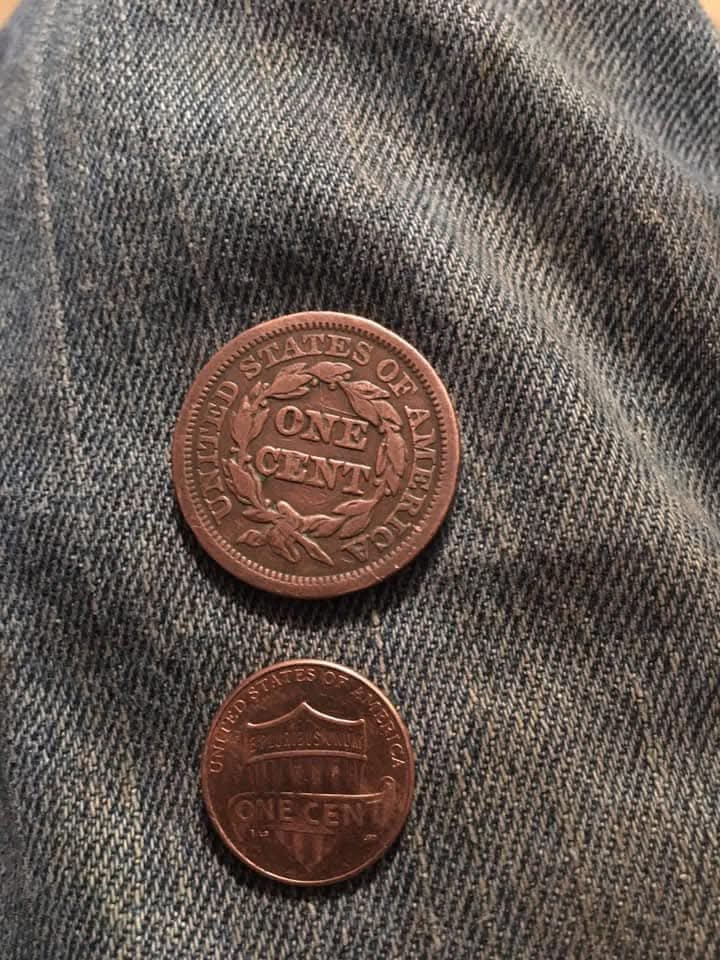
We began metal detecting the area and quickly started to find some AWESOME sign of artifacts! First we started finding several square nails to prove something had obviously stood there once upon a time. Next we found several pearlike buttons. We searched under the big rock and found a fly tox cork bottle from the 1870/80s era. We also found a big cork whiskey bottle in excellent shape! We later discovered an 1848 penny. I found a big rock and stood on it and my detector picked up a 12 gauge brass shotgun shell on one side of the rock and not far away was a second matching one. We also found several brass shotgun shell remnants of old paper shells of that era as well! 
All photos courtesy of Doc Hinck


We searched that general area several times and later while hiking around with my buddy, he discovered another boulder over the hill with more carvings in it! Being pushed for time, we have yet to detect that area or explore further.  Once this weather clears and the snow and ice thaw I fully intend to get back to exploring. Could this be an actual outlaw hideout!? 

In the last year I have been spending a lot of time doing some major research and purchased two of Emmett Dalton’s books he had written himself. As most historians know and believe, the Dalton/Doolin gang were an Oklahoma/South Kansas based gang. However, they did have a brother that lived in California and spent time there. However, everyone knows of their hideout in Oklahoma as well as their sister’s house and tunnel in Meade, but why on earth would they have one clear up here in our area you ask? 


Could there be any sort of evidence of the Daltons traveling to Northeast Kansas south of Topeka area so to speak?

While reading one of Emmett’s books, he flat stated that while they were Marshals, they began a man hunt for a Cherokee man that had committed murder. They chased him clear up north through the “Flint Hills” hmm….first thing that really struck my curiosity.  Later he states that the gang had another “hideout” that as of then had not been discovered….hmm second strike of curiosity. 

Now everyone knows that the Daltons were kin to the James and Youngers. So what does that have to do with this particular location you ask? 

Capt. Bloody Bill Anderson’s farm was not far down the trail from this exact location. This was his particular stomping grounds. He was reported to have stolen horses less than a half mile from the location! We all know who looked up to Bill and rode with him. Frank and Jesse James…..another interesting strike of curiosity! 

I began my research on the James gang and was blown away when I found newspaper articles of a Wild West show in a town not 20 minutes from the location! Frank was the main attraction! Hmm…I had discovered that Frank continued to spend a lot of time in this general area for some unknown reason. What is funny is the fact that a friend/relative had once told me that his grandfather told him that his great great grandfather use to drink and play cards with Frank James in that nearby town. We both thought it to be a neat little tall tale. That was however, until we discovered that Frank had been there at the time his great great grandfather woulda lived there!

So what on earth would bring Frank to this countryside? 

Bloody Bill made several raids in this area and several of his “gang” were “unamed”…

I recently discovered that some Kin of my very own rode with Capt. Anderson and Capt. Quantrill themselves! One of them that rode with Anderson just happened to be on a posse that was searching for Anderson and the gang after they murdered Judge A.I. Baker near Rock Creek Crossing about 20 min from this “hideout location”. Whats funny is, my Kin, and his posse never located Anderson yet, is seen on the roster of Anderson’s men in Missouri shortly after.  Could Frank and Jesse have rode with Anderson and Quantrill through these Flint Hills? There’s no way to know but a person can and will always wonder. 

Now what really got me is this! So I was at an antique auction a couple years ago and purchased a book that had a neat photo and story of Bloody Bill! I had to get to reading! When I opened up and began reading I was blown away to say the very least! It talks about “outlaws robbing some travelers along the Santa Fe Trail and burying the loot somewhere along the prairie.” It explains in detail the area where it was supposedly buried but never discovered. I literally got chills when I read it! It explains the area to a T! Exactly the same as the location where we had discovered our finds.

Now back to the hideout location. Not far from where we found everything, we dug up an all iron hatchet, an 1850s half dime and what appears to be the front of a pot bellied wood stove? We also discovered buckles off a horse harness and a couple of old ink wells. One was glass and one was pottery. We also found a few 1800s horse shoes!

There’s likely no way we’ll ever know unless we strike it rich  but my curiosity has me losing sleep at night wanting to get out and go exploring again and try to piece this story together.  The more research we do, the more the story is starting to play out and the more the dots are connecting! I haven’t had a full night’s sleep in months!

I’d love everyone’s thoughts on this!  If anyone may have any leads, or knowledge that might be of assistance I’d greatly appreciate your thoughts.


Sunday, January 12, 2025

Bob Ford, Villain or Patsy? By G.C. Stevens


                                              Bob (right) and Charley (left) Ford were both 
were present at 1318 Lafayette St, in St. Jo Missouri when Bob Ford
shot Jesse James in the back of the head, killing him, on April 03rd, 1882.
Photos courtesy the Missouri state Historic Society and Find A Grave.

03/01/20252
                                                This is an update of this article. 
As I looked back on this article and the initial incident of the killing of Wood Hite by Dick Liddil and Bob Ford . I realized that I didn't make my narrative clear enough, in that I failed to address the killing of Wood Hite. I'd like to thank Patrick Meguiar who is the VP of CSL&OH.A. for talking me through this phase of what precipitated their arrest and the eventual killing of Jesse James.
The Killing of Wood Hite for The Record
Dick Liddil and Bob Ford’s killing of Wood Hite is a gritty chapter in the story of the James Gang, rooted in personal tensions and tangled loyalties. It happened on December 4, 1881, at the home of Martha Bolton, Bob Ford’s widowed sister, in Ray County, Missouri. Wood Hite, a cousin of Jesse James and a member of the gang, had been staying there alongside Liddil and Ford. The three were part of the shrinking circle around Jesse James after the gang’s heyday had faded.
The trouble started over a mix of rivalry and resentment. Hite and Liddil both had eyes for Martha Bolton, which had been simmering for a while. But that morning, things boiled over during breakfast. Liddil later said it kicked off when Hite spoke to him, and he snapped back, refusing to talk. The spark was an old grudge—Hite had accused Liddil of pocketing $100 extra from the Blue Cut train robbery earlier that year, a claim Liddil denied. Words turned to weapons fast. Both men drew their pistols and fired almost at once. Hite’s shot hit Liddil in the leg, while Liddil’s bullet grazed Hite’s arm.
That’s when Bob Ford stepped in. Standing nearby, he pulled his own gun and shot Hite square in the head. Hite dropped, dead within minutes. Ford’s move wasn’t just about backing Liddil—some reckon he had his own score to settle, since Hite had bullied him before. Plus, Ford and Liddil were tight, and with Hite being Jesse’s cousin, keeping it quiet was urgent.
They didn’t waste time. Ford and his brother Charley (or possibly another brother, “Cap”) wrapped Hite’s body in a blanket, hauled it out on a mule, and buried it in a shallow, unmarked grave about half a mile away in the woods. Liddil, nursing his wounded leg, couldn’t help with the digging. The cover-up held for a bit, but word got out eventually—Martha’s 13-year-old son helped authorities find the body in April 1882.
This killing set off a chain reaction. Liddil, scared Jesse would come for him over his cousin’s death, surrendered to Sheriff James Timberlake in January 1882, spilling details about the gang in exchange for a pardon. Ford, meanwhile, saw a chance to cash in on the growing bounty for Jesse. Just months later, on April 3, 1882, he shot Jesse in the back, cementing his infamy. Hite’s death wasn’t just a side note—it was a domino that helped topple the James Gang for good
G.C. Stevens
Ref Good Bye Jesse James: The Jesse James Bank Museum 1967
 
In the annals of American outlaw history, few names resonate as powerfully as Jesse James. Known for his daring bank and train robberies, his Robin Hood-like mythos, and his cunning escapes from the law, Jesse James became a legend. However, his life came to an abrupt and ignominious end at the hands of one of his own gang members, Robert Newton "Bob" Ford.  But was Bob Ford a villain, or a patsy for the Governor of Missouri Thomas Crittenden?

Born on January 31, 1862, in Ray County, Missouri, Bob Ford grew up in the shadow of the Civil War, a time that shaped many of the outlaws of the era. His brother, Charley Ford, was also involved in the criminal underworld. The Ford brothers' paths crossed with Jesse James' when they joined his gang, lured by the promise of fame, money, and adventure, but also by the danger and notoriety that came with associating with such a figure.

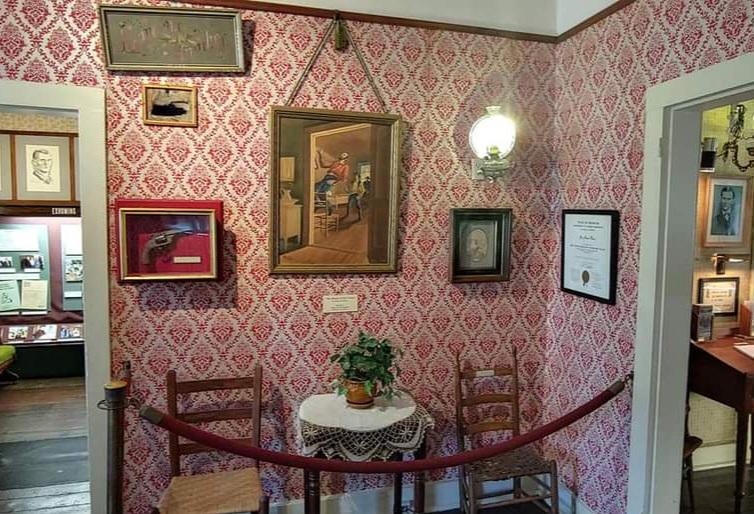
By 1882, Jesse James was a wanted man, but he had managed to evade capture for years. He trusted few, and his paranoia was well-founded. On April 3, 1882, in St. Joseph, Missouri, under the alias Thomas Howard, Jesse James was betrayed by Bob Ford, who had secretly made a deal with the Governor of Missouri, Thomas T. Crittenden. The deal promised Ford a full pardon for his past crimes and a reward for bringing Jesse to justice. In a house at 1318 Lafayette Street, while Jesse was adjusting a picture on the wall, Bob Ford shot him in the back of the head. The shot was fatal, and Jesse James died instantly, thus ending one of the most famous criminal careers in history.
 Ford was but twenty years old at the time of Jesse's killing. One can only see Bob Ford as  naive young man who was manipulated by the "new establishment" in Missouri that came to power after the civil war. A state government who not only refused to pardon the guerillas for their actions during the war, but also banned former confederate supporters from earning a living on their own soil. Thus painting the government in its own corner.  And like so many cases in modern times that have shined a light on the dubious and corrupt habits of  government to use unwitting, blackmailed or compromised operatives to accomplish their dirty work. Its easy to see the same scenario played out in the case of Jesse James and his assassination.
                                        

                               The following photos were taken by the Author 
                               at the Patee House Museum in St. Jo Missouri


                                   The location where its believed that Jesse James was killed

Bob Ford's actions were indeed controversial. While some viewed him as a traitor for killing a man in such a dishonorable way, others saw him as having done the state a service by removing a dangerous outlaw, which is a fact that cannot be overlooked. Jesse James was a cold blooded killer who engaged in war crimes during the civil war and committed many crimes before he was finally killed in St, Jo.  However, Ford's life post-assassination, was far from peaceful or prosperous.

He and his brother Charley initially received only part of the reward money and pardon from the governor who used them, and then cheated them. But the public's reaction was overwhelmingly negative. Ford faced ridicule, threats, and was ostracized. Songs and stories painted him as a coward, and the fame he sought turned into infamy. And yet his governmental handlers were never blamed for their role. They conveniently escaped accountability behind a curtain of deceit, and plausible deniability. Much in the way that Lee Harvey Oswald became the only name that would be spoken to place the label of blame for the Kennedy assassination.

In a misguided attempt to capitalize on his notoriety,  Bob Ford performed in a traveling show, reenacting the murder of Jesse James, but as could have been expected, public disdain only grew. He moved to Colorado, where he opened a saloon, but his past continued to haunt him. On June 8, 1892, Ford was shot and killed by another career criminal, Edward O'Kelley in his tent saloon in Creede, Colorado, an act that some saw as revenge for Jesse James, or simply an expression of the deep-seated contempt many felt for Ford. O'Kelly was arrested and sentenced to life in prison, but a petition was created and signed by seven thousand people in Missouri begging for O'Kellys release, he was erroneously pardoned by the governor of Colorado and released back into the public. In an Ironic twist O'Kelly got into an altercation with a Police Officer in Oklahoma City, and was shot and killed.
Little is known of O'Kelley's past, although his birthplace is reported as Harrisonville, Missouri. His mother was Margaret Ann Capehart (July 6, 1836 – July 27, 1903), but at the time of her July 14, 1857, marriage to Dr. Thomas Katlett O'Kelley (October 20, 1833 – October 9, 1923) she was already pregnant with Edward. It is believed that Thomas was not Edward's father. Edward was a child during the American Civil War. In Thomas' Civil War Veteran Pension File, where Thomas was required to list all his children and their dates of birth, Edward is not included on the list

Bob Ford's legacy is a complex one. And, history seems to have been unfair to that legacy. The fact however remains that both Bob Ford and Dick Liddil had placed themselves in a very bad situation with the murder of Wood Hite and the subsequent concealment of his corpse. He is most certainly remembered less for any heroism and more for the act of betrayal against one of America's most infamous criminals. His life illustrates the thin line between fame and infamy, honor and disgrace, in the Wild West. The tale of Bob Ford and Jesse James has been retold in numerous books, films, and songs, each adding layers to the myth of these characters.
Bob Ford's life, the murder of Jesse James and Bob Ford's subsequent murder by Ed O'Kelley, are emblematic of a times when lawlessness, government deviance, and legend intertwined in the American frontier. His story serves as a cautionary tale about the consequences of cooperating with corruption in government, betrayal, the fleeting nature of fame, and the harsh judgment of history on those who choose the path of treachery. While Jesse James' name has become synonymous with the misguided outlaw spirit of the Old West, Bob Ford's name is forever linked with the act that ended that legend, painting him as both a figure of historical significance and a pariah in the folklore of America. On an end note; After a period of deep depression following James' death, terminal illness from tuberculosis, and a debilitating morphine addiction, Charles Ford died by suicide on May 6, 1884.

The Author is the Editor of the CSL&OH.A. and Associate Member of 
the Western Writers of America.

Doc Holliday by G.C. Stevens


                             The Legend of Doc Holliday: 
                      Gunslinger, Gambler, Dentist, Enigma

                                         Photo from the Authors Collection
There I was standing on the street in Tombstone, when I was invited into the rear door of an old saloon and suddenly found myself face to face with a man at a faro table who began to tell stories of the famed gun slinger, Doc Holliday. What he told me, made realize that Doc was both a mystery and legend.
-Gene Stevens

In the tapestry of American folklore, few characters are as enigmatic and captivating as John Henry "Doc" Holliday. Born on August 14, 1851, in Griffin, Georgia, Doc Holliday was not only known for his prowess with a gun but also for his complex personality shaped by both his education and his diseases. We actually know very little about Doc except that he made his way west under mysterious circumstances, and according the one lone historian that I met on the dusty trail, Doc was not what anyone thought he was. But this is what we think we know.

Holliday was the son of Henry Burroughs Holliday, a prominent planter, and Alice Jane McKey. His upbringing was marked by privilege; he was educated at the prestigious Pennsylvania College of Dental Surgery, where he graduated in 1872. Initially, Holliday practiced dentistry in Atlanta but soon his life took a dramatic turn, and to the best of our knowledge, being diagnosed with tuberculosis. This diagnosis was a death sentence at the time, apparently pushing him westward in search of a drier climate, which was believed to be beneficial for those with lung conditions, or so the story goes.

Upon arriving in the West, Holliday found his dental practice waning in popularity, perhaps due to his own deteriorating health or the rough-and-tumble life of frontier towns. He turned to gambling, a profession that suited his quick mind and even quicker hands. His reputation grew not only as a cardsharp but also as a man not to be trifled with. His skill with firearms and a knife became legendary, though it's worth noting that much of the mythos surrounding Holliday has been embellished by Hollywood and dime novels.

One of the most pivotal relationships in Holliday's life was his friendship with Wyatt Earp. A relationship, which would have a tarnishing effect of Wyatt. Their paths crossed in Fort Griffin, Texas, and their bond was sealed in Tombstone, Arizona, where they would become embroiled in one of the most famous gunfights in American history: the Gunfight at the O.K. Corral. This incident which lasted a mere thirty seconds occurred, On October 26, 1881, Holliday and the Earps faced off against the Clantons and McLaurys. This event cemented Holliday's place in the annals of the Wild West.

Doc Holliday was known for his cool demeanor under pressure, his loyalty to friends, and his sharp wit. He was said to have had a dry sense of humor, often using it to diffuse tense situations. Despite his numerous legal troubles and brushes with the law, Holliday was never convicted of any serious crime, which adds layers to his character – was he a villain or a victim of circumstance?

The tuberculosis that drove Holliday West eventually caught up with him. By the late 1880s, his health had significantly declined. On November 8, 1887, Doc Holliday died in Glenwood Springs, Colorado, at the age of 36. His last words, according to legend, were "This is funny," a testament to his enduring sense of humor even in the face of death.

Holliday's life has been immortalized in countless books, films, and TV shows, with portrayals by actors like Kirk Douglas, Dennis Quaid, and Val Kilmer, whose performance in "Tombstone" is often cited as definitive. His story resonates not only because of his association with the Wild West but also due to the human elements of tragedy, resilience, and the quest for redemption.

Doc Holliday remains a symbol of the complexity of human character — a man who was both a product of his time and someone who transcended it through his actions, friendships, and the myths that have grown around him. His legacy is a reminder of the multifaceted nature of history's figures, where truth and legend often interweave to create something larger than life.

19th Century Photographic Resources: By G.C. Stevens

  Biographies of Western Photographers by Carl Mautz, is a highly detailed exhaustive document / listing of frontier photographers of the 19...

Readers Favorites